The Rush Window Calculus: Advanced Gate Selection Strategy During Peak Traffic Operations at US Hub Airports
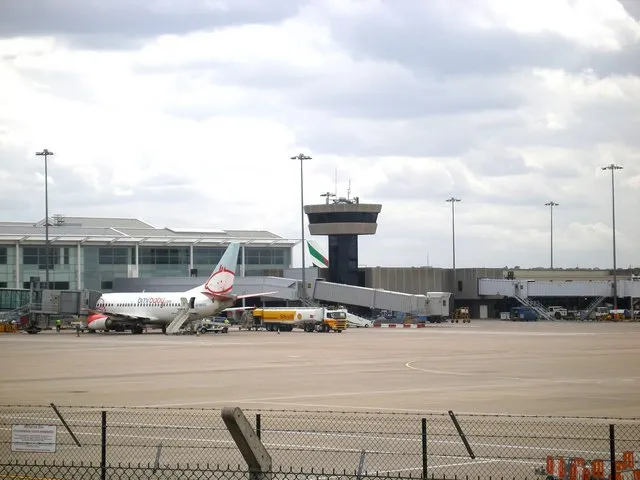
Photo: John Evans, CC BY-SA 2.0, via Wikimedia Commons
At the major US hub airports — Atlanta Hartsfield-Jackson, Dallas/Fort Worth, Chicago O'Hare, Denver International — the morning and early-evening bank windows are not simply busy periods. They are controlled detonations of coordinated activity, engineered to move hundreds of aircraft through a finite gate inventory in the shortest possible time. For the serious gate simmer, learning to operate within these windows is the difference between competent execution and genuine operational mastery.
This guide is written for simmers who have already internalized the fundamentals: aircraft-to-gate compatibility, basic turnaround sequencing, and standard ATC communication protocols. What follows is the next level — the strategic layer that professional dispatchers navigate under real-world pressure.
Understanding the Bank Structure
Most major US network carriers organize their hub operations around a bank-and-flow model. Aircraft arrive in concentrated waves — the inbound bank — unload passengers, complete ground servicing, and depart in a corresponding outbound bank. The window between arrival and departure, known as the turn time, is typically targeted between 35 and 55 minutes for narrowbody operations and 60 to 90 minutes for widebody equipment.
Within a single bank at a hub like DFW or ATL, a carrier may be managing 40 to 60 simultaneous turnarounds across multiple concourses. Gate selection decisions made at the start of the bank have compounding consequences: a suboptimal assignment in the first ten minutes can propagate into taxiway conflicts, delayed pushbacks, and missed departure slots that persist for the remainder of the window.
When you replicate this environment in simulation — using tools such as World Traffic 3, AIG Traffic, or a self-managed AI traffic layer — you are placing yourself inside this same constraint system. The strategic principles that govern real dispatcher behavior apply directly.
The Four Variables of Gate Selection
During a peak window, every gate assignment decision is a trade-off across four primary variables.
Aircraft-Gate Compatibility
This is the baseline constraint. A widebody cannot occupy a narrowbody gate; an aircraft with an incompatible jetway geometry cannot be efficiently boarded regardless of scheduling pressure. In simulation, your scenery package's gate definitions — expressed as ICAO aircraft class codes or wingspan thresholds — establish the hard limits within which all other decisions occur.
Proximity to the Active Runway Complex
During a compressed bank, taxi time is not a trivial variable. A gate assignment that adds four minutes of taxi distance to an aircraft's outbound sequence can translate directly into a missed departure slot, particularly when ATC is managing a dense flow of departures on a single runway configuration. Favor gates with direct taxiway access to the anticipated departure runway whenever scheduling flexibility permits.
Turnaround Service Accessibility
Not all gates offer equal access to ground service equipment. Interior gates on congested concourses may have limited fuel truck positioning angles, restricted catering vehicle access, or shared baggage belt loader staging areas. During a peak window, these physical constraints can extend a turnaround by ten minutes or more — a significant cost when the bank close time is fixed.
Downstream Gate Availability
An advanced dispatcher does not assign a gate solely based on the current inbound aircraft. They account for what aircraft will need that gate next. Assigning a long-haul widebody to a gate that is scheduled to receive a quick-turn narrowbody 90 minutes later creates a recovery problem if the widebody's turn runs long. In simulation, this requires maintaining a mental — or written — gate utilization timeline across the full bank window.
Decision Trees for Common Peak-Window Scenarios
Scenario One: Simultaneous Arrivals, Insufficient Gate Inventory
You are managing a simulated bank at Chicago O'Hare. Three aircraft arrive within a six-minute window. You have two open compatible gates and one gate currently occupied by an aircraft that is ten minutes from pushback clearance.
The optimal sequence: assign the two arriving aircraft to the open gates immediately. Hold the third arriving aircraft in a remote parking position or request a gate hold from ATC. Do not delay the departing aircraft's pushback to accelerate the gate turnover — the risk of a pushback conflict with the holding arrival outweighs the time saved. Once the third gate clears, sequence the held aircraft in.
Scenario Two: Equipment Swap Mid-Bank
An inbound aircraft has been substituted with a larger equipment type than originally scheduled. The assigned gate cannot accommodate the new aircraft class.
This scenario demands immediate downstream analysis. Identify the nearest compatible gate. Evaluate whether that gate's current or scheduled occupant can be repositioned without creating a cascade conflict. If a compatible gate is unavailable within the bank window, consider whether a remote stand with ground transport can preserve passenger flow while protecting the gate inventory for higher-priority turns.
Scenario Three: Pushback Conflict at the Bank Close
Multiple aircraft are ready for pushback simultaneously, but the taxiway geometry at your simulated terminal permits only sequential departures. The bank close window is six minutes away.
Prioritize by downstream connection criticality, not by arrival sequence. Aircraft carrying passengers with tight connecting windows should receive pushback priority. This mirrors the real-world practice of connection protection, where dispatchers and ground coordinators collaborate to sequence departures based on the connecting passenger load, not simply first-in-first-out logic.
Integrating Real Dispatcher Insights
Professional airline dispatchers who manage hub bank operations describe the peak window as a constraint satisfaction problem with a moving horizon. Every decision closes off some future options while opening others. The discipline is not in making perfect decisions — it is in making decisions quickly enough that the window does not close before the board is cleared.
For simmers, this translates into a specific practice recommendation: before beginning a peak-window session, map the full bank structure. List every expected arrival, its equipment type, its target gate, and its scheduled turn time. This pre-session planning mirrors the dispatcher's pre-bank briefing and gives you the situational awareness to make rapid decisions when the window opens.
Building the Skill Through Deliberate Practice
The rush window calculus is not learned in a single session. It develops through repeated exposure to high-pressure gate scenarios and systematic post-session review. After each simulated bank, audit your decisions: Which assignments created downstream conflicts? Where did taxi time add unnecessary delay? Which turnarounds ran long, and why?
This after-action discipline — borrowed directly from professional aviation operations review — accelerates skill development faster than any amount of passive reading. The goal at VDG SimDock is not merely to simulate the gate. It is to develop the operational judgment that makes every gate decision, under any traffic condition, a considered and defensible one.