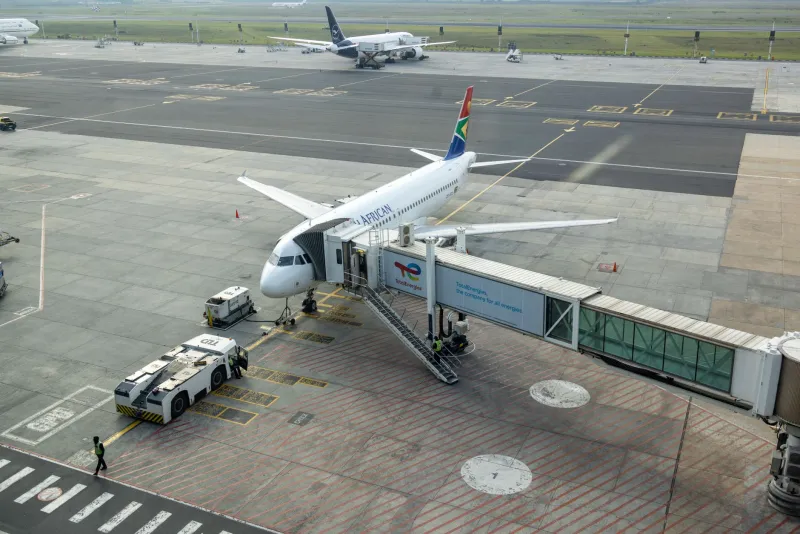
Vectors, Wind, and the Gate: The Science Behind a Flawless Docking Approach

There is a moment, familiar to every serious flight simulation enthusiast, when the jetway bridge creeps into view through the cockpit glass and the centerline painted on the tarmac seems impossibly narrow. That moment is not coincidence—it is the product of dozens of micro-decisions made across the final miles of an approach. At VDG SimDock, we have long maintained that mastering the gate is the truest test of a simmer's aerodynamic understanding. This article examines precisely why that is, drawing on real-world aviation science to explain what is happening—physically and operationally—every time you line up for a gate.
Why Approach Geometry Is Not Optional
Commercial and general aviation pilots alike are trained to think of an approach as a geometric problem. The Instrument Landing System (ILS) defines a glideslope—typically 3 degrees above horizontal—and a localizer that centers the aircraft laterally on the runway extended centerline. What many simmers do not fully appreciate is that this geometry does not end at the runway threshold. It continues, conceptually, all the way to the parking stand.
When you fly a shallow, stabilized approach into a major hub like Chicago O'Hare or Hartsfield-Jackson Atlanta, you are threading a three-dimensional corridor defined by obstacle clearance surfaces, noise abatement procedures, and traffic separation standards. Deviating from that corridor—even by a small margin—creates a cascading series of corrections that compound as you get closer to the ground. In simulation, the consequence is a messy rollout and an awkward gate stop. In the real world, the stakes are considerably higher.
The practical lesson for VDG SimDock users is straightforward: begin thinking about your gate well before you intercept the final approach fix. Visualize the entire corridor from cruising altitude to the painted nose-wheel stop line on the ramp. That mental model is exactly what real first officers are taught to construct during approach briefings.
Wind Correction Angles: The Invisible Force Shaping Every Approach
Of all the variables that affect approach precision, crosswind is arguably the most misunderstood among newer simmers. A crosswind does not simply push an aircraft sideways—it continuously attempts to displace it from the intended track, and the required correction changes as groundspeed decreases on final approach.
The standard technique for managing crosswind on approach is the crab method, in which the aircraft is pointed slightly into the wind to maintain the desired ground track. The angle of this crab—known formally as the wind correction angle (WCA)—is calculated using the relationship between crosswind component and true airspeed. As an aircraft slows from approach speed to taxi speed, the same crosswind represents a proportionally larger correction requirement. This is why pilots must progressively refine their WCA throughout the approach, and why a correction that felt adequate at 160 knots may leave the aircraft significantly off centerline by 30 knots on the taxiway.
VDG SimDock's docking scenarios are specifically designed to surface this challenge. Our wind modeling does not simply apply a uniform push—it simulates the variable gusts and directional shifts that characterize real terminal environments, particularly at airports situated in open plains like Denver International or coastal facilities such as San Francisco International, where marine layer conditions create unpredictable low-level wind shear.
To practice WCA management effectively, try this exercise: load a scenario with a 15-knot crosswind and fly the approach without using any autopilot lateral modes. Note the crab angle required at the outer marker, at the middle marker, and at 50 feet above the threshold. The progressive refinement you perform instinctively is the same computation professional pilots internalize over hundreds of hours of training.
Energy Management: The Overlooked Dimension of Gate Precision
Alignment is only half of the docking equation. The other half is energy—specifically, the management of kinetic and potential energy as the aircraft transitions from flight to taxi. Arriving at the gate with excess speed is not merely a scoring penalty in VDG SimDock; it reflects a fundamental breakdown in energy management that real-world procedures are designed to prevent.
Stabilized approach criteria, used by virtually every major US carrier, require that an aircraft be configured for landing, on glidepath, and at target airspeed by a defined altitude—typically 1,000 feet above field elevation in instrument conditions, 500 feet in visual conditions. An unstabilized approach is considered a mandatory go-around trigger at most airlines. The reason is not bureaucratic caution; it is physics. An aircraft that is fast, high, or improperly configured at 500 feet has insufficient runway remaining to safely absorb the energy differential.
In the context of VDG SimDock's gate docking scenarios, energy management translates directly to the smoothness and precision of your final taxi. A pilot who arrives over the threshold at precisely the target speed, with flaps and speedbrakes configured correctly, will find the rollout intuitive and the turn onto the ramp natural. A pilot who arrives fast will be chasing the aircraft all the way to the jetway.
Building Muscle Memory Through Repetition
The neurological science of skill acquisition is clear on one point: repetition in a low-stakes environment accelerates performance in high-stakes conditions. Flight simulators have been used for this purpose since Link Trainers equipped Army Air Forces pilots during World War II. The principle has not changed, but the fidelity of modern simulation has made the transfer of learning dramatically more effective.
When VDG SimDock users repeatedly practice a precision gate approach—correcting for crosswind, managing energy, maintaining the approach corridor—they are encoding procedural knowledge into long-term motor memory. Experienced pilots who use simulation regularly consistently report that their real-world approaches feel more deliberate and controlled because the cognitive load of basic aircraft handling has been reduced through simulated repetition.
This is not a trivial benefit. It is the reason major US flight training academies and regional carriers have integrated simulator hours into their curricula at an unprecedented scale. The gate, it turns out, is not the end of the flight—it is the measure of everything that preceded it.
Putting It Into Practice on VDG SimDock
If you are looking to sharpen your approach discipline, consider the following structured practice regimen within the platform. Begin each session with a thorough weather briefing, paying particular attention to surface winds at your destination. During the approach, call out your wind correction angle at each defined fix, just as a real crew would during a sterile cockpit procedure. Set personal stabilization gates—altitude thresholds at which you evaluate your energy and alignment—and commit to a go-around if you do not meet the criteria.
The physics of a perfect approach are not mysterious. They are learnable, repeatable, and deeply satisfying to execute. At VDG SimDock, mastering the gate is how you begin to own the skies.