Mirror Blindness: Understanding the Spatial and Aerodynamic Divide Between Port and Starboard Gate Approaches
There is a particular frustration that visits experienced simulator pilots without warning. You have spent considerable time refining your gate approach on the left side of the aircraft — the captain's side — until it feels almost mechanical in its precision. Then you rotate the scenario, face a right-side gate assignment, and discover that your confidence evaporates somewhere between the taxiway turnoff and the jetway. The approach feels foreign. The visual cues do not line up the way your muscle memory expects. You overshoot the centerline by a margin that would embarrass a student.
This experience is not a personal failing. It is the natural consequence of a genuine technical asymmetry — one that exists both in the real world of commercial aviation and, when properly modeled, within high-fidelity simulation environments. Understanding that asymmetry is the first step toward eliminating it.
Why the Two Sides Are Never Truly Equal
The foundational assumption most pilots carry into gate operations is that an aircraft is a symmetric object moving through a symmetric environment. Neither is entirely true. At the structural level, jet engines on multi-engine aircraft do not always produce perfectly identical thrust vectors, particularly during the low-power taxi and docking phase when even minor torque imbalances become perceptible. On single-aisle aircraft with engines mounted below the wing, asymmetric ground effect during slow forward movement can produce subtle yawing tendencies that vary depending on crosswind direction and ramp surface grade.
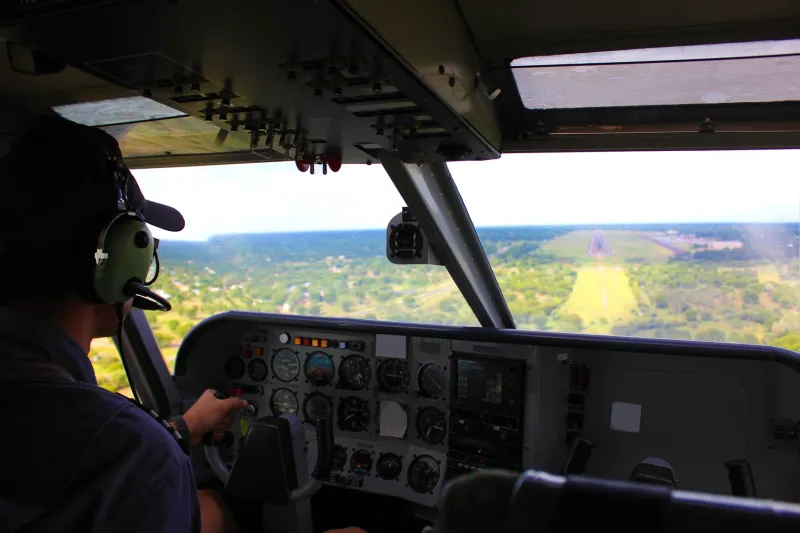
More consequentially, the pilot's position within the cockpit creates an inherent left-side visual advantage. The captain's seat places the left eye at a specific lateral offset from the aircraft centerline. When approaching a left-side gate, this offset works in the pilot's favor — the reference markers painted on the ramp surface, the VDGS (Visual Docking Guidance System) display, and the wing tip clearance all fall within a comfortable visual cone. Approaching a right-side gate from the same seat requires the pilot to extrapolate spatial information across the aircraft's nose, a cognitively demanding task that introduces latency into corrective inputs.
Simulation platforms that model cockpit geometry with high fidelity — including accurate instrument panel offsets and window frame occlusion — reproduce this disadvantage accurately. If your preferred simulator does not seem to penalize right-side approaches, it is worth examining whether the cockpit model is geometrically precise or whether the developer has simplified the spatial representation.
How Simulator Physics Models the Asymmetry
Modern flight simulation engines handle lateral asymmetry through several interconnected systems. Aerodynamic modeling accounts for differential ground effect as a function of wing geometry and surface proximity. Taxi dynamics incorporate tire friction coefficients that may vary slightly by surface condition, producing different steering responses depending on which direction the aircraft is turning into its final gate alignment.
Perhaps the most significant modeling variable is the VDGS integration. High-quality airport add-ons for US hub airports — including scenery packages representing O'Hare, LAX, and Atlanta Hartsfield-Jackson — implement VDGS units that are positioned specifically relative to each gate's physical layout. A left-side gate typically places the VDGS display directly in the captain's forward sightline. A right-side gate may position the display at an angle that requires the pilot to read it peripherally or to mentally translate the guidance arrows relative to a mirrored reference frame.
This mirroring effect is cognitively underappreciated. When a VDGS unit indicates a correction to the pilot's right, the appropriate steering input on a right-side gate approach is the opposite of what a left-side approach would demand under visually similar circumstances. Pilots who have not explicitly trained this distinction will hesitate at the moment of correction, and hesitation at low taxi speeds compounds quickly into overcorrection.
The Three Most Common Mistakes When Switching Sides
Reference Point Fixation. Pilots who have developed reliable left-side approach reference points — a specific nose position relative to the gate signage, a wing tip relationship to the apron edge — frequently attempt to apply those same reference points to right-side approaches. Because the pilot's eye is in a fixed left-of-center position, identical visual relationships between external objects and the cockpit window frame correspond to different actual aircraft positions depending on which side of the aircraft the gate occupies. Applying left-side reference points to a right-side gate will consistently produce an approach that is offset to the left of centerline.
Delayed Crosswind Correction. Crosswind affects the two approach geometries differently. A left-crosswind component during a right-side gate approach pushes the aircraft toward the gate structure, compressing the margin for error and demanding earlier corrective input than the equivalent left-side scenario. Pilots trained primarily on left-side approaches in calm or right-crosswind conditions may carry an unconscious expectation of available correction time that simply does not exist on the opposite side.
VDGS Misinterpretation Under Pressure. As noted above, reading VDGS guidance requires a mental translation step when the display is not in the pilot's direct forward sightline. Under the time pressure of a busy virtual ramp — particularly in multiplayer environments simulating US hub operations during peak hours — that translation step gets abbreviated. Pilots report consistently misreading lateral guidance arrows during right-side approaches at a rate that does not appear during left-side operations.
Practical Drills for Building Symmetric Competency
The most effective remediation is deliberate, isolated practice — not general gate operations, but structured repetition of the specific sub-skills that the asymmetry challenges.
The Centerline Calibration Drill. Select a gate pair at a major US hub add-on — one left-side gate and one right-side gate with similar ramp geometry. Approach each gate ten consecutive times from the same entry taxiway, recording your lateral offset at the stop line. Do not proceed to the next session until both gates produce offset distributions within the same tolerance band. This drill forces the pilot to build independent reference point libraries for each side rather than attempting to transfer a single framework.
The Mirrored VDGS Response Drill. Configure your simulator to display an exaggerated lateral offset — approximately two meters — at the start of each approach, alternating the direction of offset between sessions. Practice responding to VDGS correction commands without visual confirmation from the nose reference, relying entirely on the display reading. This isolates the cognitive translation task and builds the habit of trusting instrumentation over intuition.
Crosswind Side-Switching. Set a consistent five-knot crosswind and alternate between left-side and right-side gate approaches in the same session. The crosswind will have opposite effects on each approach geometry, forcing you to consciously recalibrate your correction timing rather than operating on autopilot from one side to the next.
Closing the Gap
Symmetric gate competency is not a natural consequence of accumulated flight hours. It is a specific skill that requires specific attention. The pilots — and by extension, the simulator operators — who recognize this are the ones who can be assigned to any gate in the terminal without a degradation in performance.
At VDG SimDock, the standard we hold is not merely competence on the preferred side. It is the ability to read an unfamiliar gate assignment, assess the geometry regardless of which side of the aircraft the jetway occupies, and execute a docking approach that meets the same precision threshold every time. That standard begins with understanding why the asymmetry exists — and respecting it enough to train against it directly.