The Tug Bottleneck: How Ground Equipment Scarcity Cascades Into Terminal-Wide Paralysis
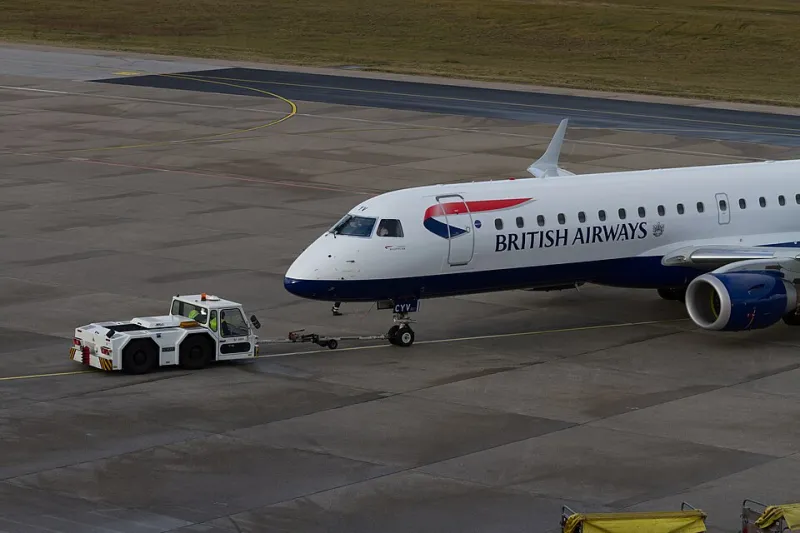
Photo: Matti Blume, CC BY-SA 4.0, via Wikimedia Commons
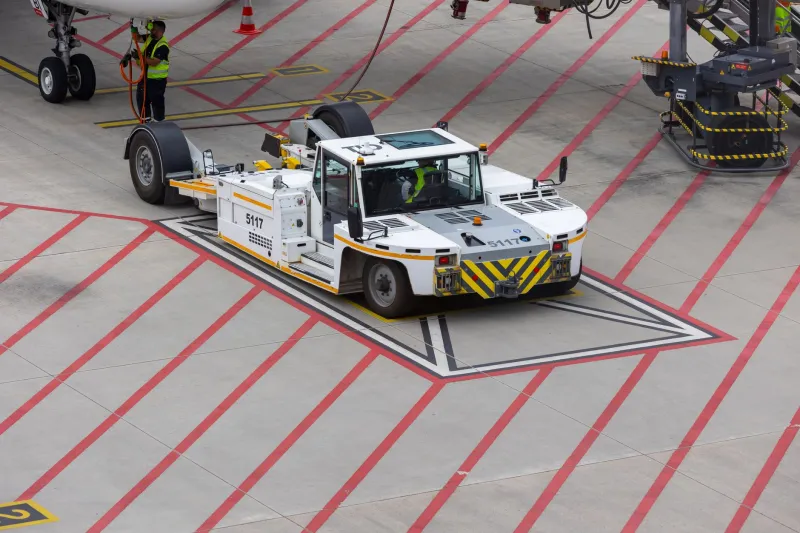
The pushback tug occupies a peculiar position in the hierarchy of airport ground equipment. It is indispensable — no aircraft under its own power can exit a forward-facing gate — yet it is among the most underrepresented systems in flight simulation environments. Most simmers interact with the tug only at the moment of pushback request, never considering where the vehicle came from, how it was allocated, or what competing demands it might have satisfied instead.
This invisibility is not an accident of simulation design. It reflects a broader tendency to treat ground equipment as a background service rather than a constrained resource with its own scheduling logic. In the real world, tug conflicts are a primary driver of gate delay, and at major US hubs during peak operations, the competition for available pushback equipment can be as consequential as runway congestion.
Understanding this dynamic — and replicating it authentically in simulation — separates casual gate operators from practitioners who genuinely grasp the systemic complexity of airport ground operations.
The Anatomy of a Tug Fleet
At a major US hub airport, the ground handling contractor responsible for a given carrier's operations maintains a fleet of pushback tugs sized to meet average demand, not peak demand. This is a deliberate economic decision: equipment that sits idle during off-peak hours represents capital cost without return. The consequence is that during bank operations — when 40 or more aircraft may require pushback within a 30-minute window — the fleet is structurally undersized relative to instantaneous demand.
Tugs within the fleet are not interchangeable. Towbarless tractors, which grip the nose gear directly, are rated for specific aircraft weight classes. Conventional tow tractors require compatible towbar adapters, which are themselves a separate inventory item. A tug that is correctly rated for a 737 may be incompatible with an A321 or a regional jet without a change of equipment or adapter. This equipment heterogeneity means that even when a tug is nominally available, it may not be deployable against a specific pushback request.
Priority Logic in Real Ground Coordination
When multiple aircraft request pushback simultaneously and the available tug inventory cannot satisfy all requests at once, ground coordinators apply a structured priority framework to sequence the assignments.
Departure slot protection sits at the top of the hierarchy. Aircraft holding a filed departure slot with ATC — particularly those operating under EDCT (Expect Departure Clearance Time) restrictions during ground delay programs — receive tug priority regardless of their position in the request queue. Missing an EDCT window carries significant operational and financial penalties, making slot protection a non-negotiable priority.
Connection criticality is the second tier. Dispatchers communicate to ground coordinators which departing flights carry passengers with tight connecting itineraries. A flight that is the last bank departure serving a spoke city, or one carrying a high volume of international connections, will receive tug priority over a flight with schedule buffer or a point-to-point itinerary.
Equipment compatibility shapes the practical allocation even within these priority tiers. Ground coordinators maintain real-time awareness of which tugs are compatible with which aircraft types and route assignments accordingly. A coordinator who dispatches a towbarless tractor rated for widebody operations to push a regional jet has wasted a high-value asset that may be urgently needed at an adjacent widebody gate.
Physical proximity governs the final allocation when all other factors are equal. The tug that can reach the requesting gate fastest — accounting for taxiway routing, other ground vehicle traffic, and equipment staging positions — receives the assignment. This is not merely an efficiency preference; in a compressed bank window, every minute of tug transit time is a minute subtracted from the available turn time.
Simulating Tug Scarcity Authentically
Most simulation platforms default to an idealized tug model: the vehicle appears promptly upon request, performs the pushback, and returns to an undefined staging area. This frictionless model eliminates the most operationally significant aspect of tug management — scarcity.
Recreating realistic tug scarcity requires deliberate configuration choices. In GSX Pro, the ground services timing parameters can be adjusted to introduce realistic transit delays between the tug's last assignment and its arrival at the next requesting gate. Setting these delays to reflect actual ramp distances — typically two to eight minutes depending on terminal geometry — immediately transforms the tug from an on-demand service into a scheduled resource.
For simmers managing AI traffic through World Traffic 3 or similar platforms, the tug conflict dynamic becomes visible at the fleet level. When multiple AI aircraft request pushback simultaneously, observing which requests are serviced first and which are delayed reveals the implicit priority logic embedded in the add-on's scheduling algorithm. Comparing this behavior against the real-world priority framework described above highlights where the simulation diverges from authentic practice — and where manual intervention can improve fidelity.
The Cascade Mechanism
The reason tug conflicts matter beyond the immediate delay is their cascade potential. A single pushback delay does not affect only the aircraft waiting for the tug. It affects the gate that aircraft is occupying, which cannot accept the next inbound aircraft until the current occupant clears. The inbound aircraft, unable to reach its assigned gate, may be held on a taxiway — blocking traffic behind it. The taxiway blockage delays other departures waiting for their own pushback clearance. Within fifteen minutes, a single tug conflict at one gate has produced a multi-aircraft delay sequence spanning an entire concourse.
This cascade is not a theoretical concern. Ground operations managers at major US hubs identify tug availability as one of the top three controllable causes of on-time performance degradation during bank operations, alongside fueling delays and late catering.
In simulation, triggering this cascade deliberately — by withholding a tug assignment during a peak window and observing the downstream consequences — is one of the most instructive exercises available to a serious gate operator. The experience of watching a single resource constraint propagate through an entire terminal makes abstract operational concepts viscerally concrete.
What This Means for the Serious Simmer
Incorporating realistic tug scheduling into your simulation practice is not simply an exercise in technical fidelity. It is a cognitive discipline. Managing a constrained tug fleet during a compressed bank window requires the same kind of multi-variable prioritization that defines expert performance in real ground operations.
Begin by auditing your current tug interaction patterns. Do you request pushback without considering whether the tug could be more urgently needed at an adjacent gate? Do you sequence your pushback requests to minimize tug transit distances? Do you apply any form of priority logic when managing multiple simultaneous departure requests?
If the answer to these questions is no, you are leaving a significant dimension of gate operations unexplored. At VDG SimDock, the goal has always been to simulate not just the visible mechanics of airport operations, but the invisible resource constraints that give those mechanics their real-world texture. The tug is where that texture is most often lost — and most powerfully recovered.