Off-Balance at the Stand: How Center-of-Gravity Errors Quietly Invalidate Your Gate Assignment

The weight-and-balance calculation is one of those pre-departure disciplines that simulation tends to treat as a checkbox rather than a consequence. You enter the numbers, the system accepts them, and you proceed. What the simulation rarely communicates is that those numbers carry forward — that a center-of-gravity error which was invisible at cruise altitude can become a concrete operational problem in the final hundred feet of a gate approach. Understanding why requires a closer look at what the gate actually demands from an aircraft's balance envelope.
What CG Actually Controls at the Gate
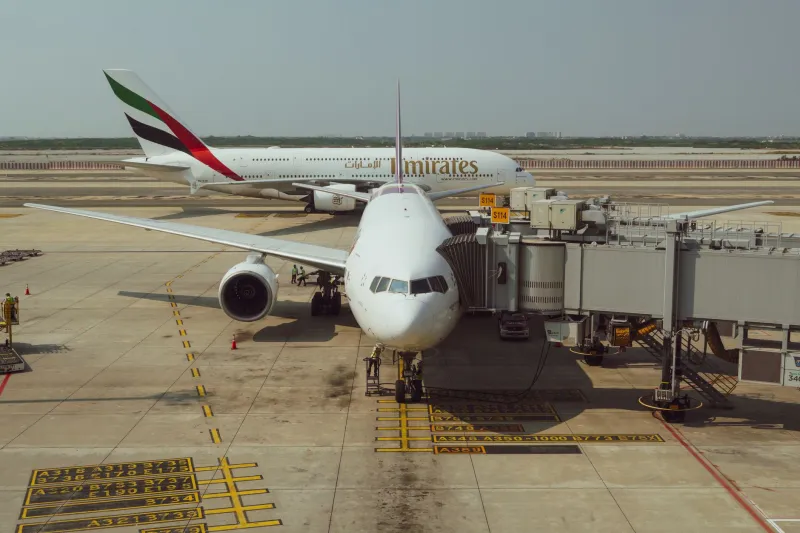
Center of gravity, expressed as a percentage of mean aerodynamic chord, governs far more than pitch stability in flight. At the gate, it determines the load distribution between the nose gear and the main gear. That distribution is not merely a structural consideration — it is an operational one. Airport gate infrastructure, including jetway bridge arms, ground power cable reach, nose gear chock placement zones, and VDGS sensor calibration, is designed around a specific range of nose gear positioning. When an aircraft arrives with a CG that is significantly forward or aft of its expected envelope, the nose gear may not stop where the gate infrastructure expects it to.
A forward CG — more weight toward the nose — places excessive load on the nose gear. This is a maintenance concern that ramp crews are trained to identify, and it can result in a ground stop being called at the stand. In extreme cases, it affects the physical clearance between the nose section and the jetway bridge, particularly on aircraft types where the bridge connects near the forward door. A CG that is aft of limits creates the opposite problem: the nose gear is underloaded, which reduces steering effectiveness during the final approach and increases the risk of the aircraft stopping short of the target zone, misaligning the door with the jetway.
The Cruise-to-Gate Continuity Problem
Here is where simulation tends to fail the serious student of gate operations. Most flight simulation platforms treat cruise and gate approach as independent phases with no meaningful data continuity between them. You can fly with a CG that is technically out of limits for the entire flight, land without incident, and taxi to the gate without any system flagging the discrepancy. The load sheet you filed before departure is not compared against any real-time measurement of actual aircraft state.
In real-world operations, this continuity is maintained through several mechanisms. Fuel burn is tracked against the planned burn curve, and significant deviations — caused by asymmetric fuel consumption, cross-feed errors, or an uncorrected fuel imbalance — are flagged by the flight management system. When the aircraft arrives at the destination with a fuel distribution that differs materially from the plan, the resulting CG shift is calculable. Dispatchers and load planners at the destination are informed, and the gate assignment may be reviewed in light of the revised balance condition.
This is the connection that most simmers miss. A fuel asymmetry that developed during cruise — perhaps because a cross-feed valve was left in the wrong position, or because one engine ran slightly richer than planned — does not reset when the wheels touch down. It arrives at the gate with the aircraft, and it affects every subsequent ground operation.
Fuel Asymmetry as the Silent CG Disruptor
Fuel asymmetry deserves particular attention because it is both common and commonly ignored in simulation. When the fuel load in the left and right wing tanks is not equal, the aircraft's lateral CG is displaced from the centerline. On most commercial aircraft types, lateral CG limits at the gate are tighter than they are in flight, because the aircraft is no longer generating lift to compensate for the imbalance. A lateral CG displacement that was within limits at cruise altitude may exceed ground limits upon landing.
The practical consequence is that the aircraft may sit with a visible wing-low attitude on the stand. Ramp crews are trained to observe this and report it to maintenance. In some cases, fueling is required before ground operations can continue, not to add range but to restore lateral balance. Jetway positioning may need to be adjusted to account for the door height differential created by the wing-low attitude. These are not theoretical concerns — they occur at major US carriers with enough frequency that standard operating procedures address them explicitly.
For the simmer, this means that fuel management during cruise is not separate from gate operations. It is upstream preparation for them. Allowing a fuel imbalance to develop and persist throughout a flight is not a minor procedural shortcut; it is a decision that will have downstream consequences at the stand.
How Add-On ATC Systems Respond to CG Anomalies
Advanced ATC and ground handling add-ons implement gate assignment logic that, in some cases, references aircraft state data including weight and CG position. When these systems reject an assignment or issue a hold command during the gate approach, the cause is frequently not a software error — it is the system correctly identifying that the aircraft's current state is incompatible with the assigned stand.
The rejection logic typically operates against a set of threshold values derived from the aircraft type's ground operations manual. If the nose gear load is calculated to exceed the stand's rated capacity, or if the CG position would place the aircraft's door outside the jetway's reach envelope, the system will flag the assignment as invalid. From the simmer's perspective, this looks like an arbitrary block on what appears to be a valid gate. Understanding the underlying logic reveals that the block is neither arbitrary nor invalid — it is the system doing precisely what it should.
Building CG Awareness Into Your Pre-Gate Discipline
The corrective approach for serious simmers is to treat the weight-and-balance calculation as a living document rather than a departure-phase formality. Before beginning the gate approach, review your current fuel state against your planned fuel state. Calculate the actual CG position based on current load distribution, not the position you filed at departure. If the two differ materially — particularly if a fuel imbalance has shifted the CG toward or beyond a limit — treat that as an operational condition requiring resolution before proceeding to the stand.
In practice, this means using your simulation's fuel management tools to equalize wing tanks before the gate approach, verifying that your load sheet CG position remains valid given actual fuel burn, and understanding which gate stands at your destination have the tightest nose gear positioning tolerances. Wide-body stands at congested terminals like those at LAX's Tom Bradley International Terminal or JFK's Terminal 4 have less margin for deviation than general aviation or regional stands. Knowing your aircraft's actual balance condition before you enter that environment is the mark of a dispatcher-level operator.
The gate does not forgive errors that originated three hours earlier over Kansas. At VDG SimDock, the standard is to arrive at the stand the same way you departed it: with numbers that are verified, balanced, and operationally valid.