When the Air Fights Back: Understanding Wind Shear's Invisible Role in Gate Approach Failures
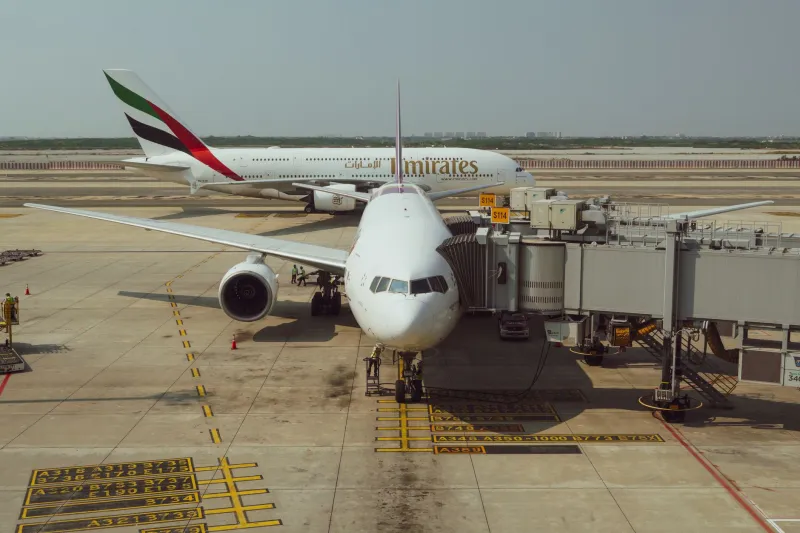
There is a particular kind of frustration that experienced simmers know well: the approach is clean, the centerline is locked, the VDGS is reading green — and then, in the final thirty feet, something shifts. The nose drifts. The alignment breaks. What looked like a textbook gate entry becomes a recovery exercise with a jetway in the way.
In the real world, that drift often has a name: wind shear.
Most flight simulation add-ons model wind as a consistent directional force. It blows from a heading, at a speed, and your aircraft responds accordingly. What they rarely capture is the vertical component of wind shear — the abrupt change in wind velocity and direction across a narrow altitude band — or the turbulent eddies that form when prevailing crosswinds interact with terminal buildings, jetway structures, and parked wide-body aircraft on adjacent stands. These are not edge cases. At major US hub airports, particularly those with parallel concourses and high terminal density, they are routine operational considerations.
The Physics of Terminal-Zone Turbulence
When an aircraft is taxiing at low speed toward a gate, it is operating in a fundamentally different aerodynamic environment than it was on final approach. The engines are at near-idle thrust. The control surfaces are largely irrelevant. Directional authority is almost entirely a function of nose gear steering and differential braking. In this configuration, even modest wind forces — forces that would be trivial at cruise altitude — carry meaningful consequences.
Crosswinds blowing perpendicular to the gate face create lateral pressure on the fuselage, which acts as a sail. A 15-knot crosswind component striking a wide-body aircraft broadside during the final approach to a gate generates enough lateral force to require active correction from the flight crew. On a narrow-body, the effect is proportionally smaller but still present. The problem is that terminal structures themselves are not passive in this dynamic. Buildings channel and accelerate wind, creating localized gusts that can exceed the ambient wind speed by a significant margin.
Vertical wind shear adds a second dimension to this problem. When a low-level wind shear event occurs near the terminal — often associated with frontal passages, convective activity, or even the mechanical turbulence created by large jet exhausts from departing aircraft — the wind profile can shift dramatically between the aircraft's tail and its nose. The crew may be compensating for a headwind component at the tail while the nose is simultaneously experiencing a crosswind. Coordinating those competing corrections during a slow, close-quarters maneuver is a genuine skill.
What Real Pilots Do That Simulators Don't Show You
Veteran airline pilots operating into high-density terminals — think O'Hare, Atlanta Hartsfield-Jackson, or Dallas/Fort Worth — develop a set of compensatory habits that most simulation environments never demand. Chief among them is the practice of pre-positioning the aircraft slightly upwind of the centerline before entering the gate zone, allowing the crosswind to drift the nose back toward alignment as the aircraft decelerates. This is not a technique found in most standard operating procedures. It is accumulated institutional knowledge, passed between crews informally, and refined over hundreds of gate entries at specific airports.
Pilots also adjust their approach speed profile based on wind conditions near the terminal. A gusty crosswind environment calls for a slightly higher taxi speed maintained later in the approach, preserving directional authority for longer before the final deceleration. Counterintuitively, slowing down too early in a crosswind actually reduces the pilot's ability to correct, because nose gear steering effectiveness diminishes with speed.
Low-visibility gate approaches compound all of these challenges. When VDGS guidance is the primary reference and visual cues from the jetway are obscured by fog, rain, or darkness, the pilot has fewer redundant data sources to catch a developing alignment error. The margin for correction shrinks precisely when the need for correction is hardest to detect.
What This Means for Serious Simulation Training
Most commercial flight simulation add-ons, even premium ones, do not model terminal-zone wind shear with any meaningful fidelity. The wind environment at the gate is typically identical to the wind environment on the taxiway, which is itself a simplified representation of the broader weather scenario. For simmers who treat gate operations as a core discipline rather than a transition between flights, this is a significant gap.
There are practical ways to address it without waiting for add-on developers to close the gap. The first is deliberate scenario construction. Setting your weather environment to include moderate crosswind components — 10 to 18 knots from a direction perpendicular to your intended gate face — and then flying the approach without autopilot or taxi-assist systems active will force you to develop the same compensatory habits that real crews use. It will not replicate wind shear precisely, but it will build the underlying skill of managing directional pressure during low-speed maneuvering.
The second approach is to study the specific terminal geometry of your chosen airport. Identify which gate faces are most exposed to prevailing wind directions. At airports like Denver International, where winds frequently exceed 20 knots from the northwest, certain concourse orientations create consistently challenging gate approach conditions. Building that geographic awareness into your pre-departure planning — and adjusting your approach technique accordingly — is exactly the kind of layered operational thinking that separates disciplined simulation from casual flying.
Finally, consider integrating real-time weather injection tools that pull live METAR data into your simulation environment. When the real O'Hare is reporting gusty conditions, your simulated gate approach should reflect that reality. The goal is not to make the simulation harder for its own sake. It is to ensure that the skills you develop at the virtual gate are transferable to a genuine understanding of what real crews manage every time they pull into a stand.
The Gate as an Aerodynamic Environment
The dominant narrative in flight simulation treats the gate as the end of the aerodynamic story. The aircraft has landed, decelerated, and navigated the taxiway system. The gate is where physics stops and logistics begin. That framing is incorrect, and it produces simmers who are unprepared for the genuine complexity of terminal-zone operations.
Wind does not stop at the concourse door. It accelerates through gaps between buildings, rebounds off glass facades, and swirls in the wakes of parked aircraft. Understanding that the final thirty feet of a gate approach is still an aerodynamic event — one that demands active management and situational awareness — is the foundation of authentic gate operations training. At VDG SimDock, that level of fidelity is not optional. It is the standard.