The Fifteen-Minute Fault Line: How One Immovable Wide-Body Collapses an Entire Terminal's Gate Sequence

Photo by Photo by Pim de Boer on Unsplash on Unsplash
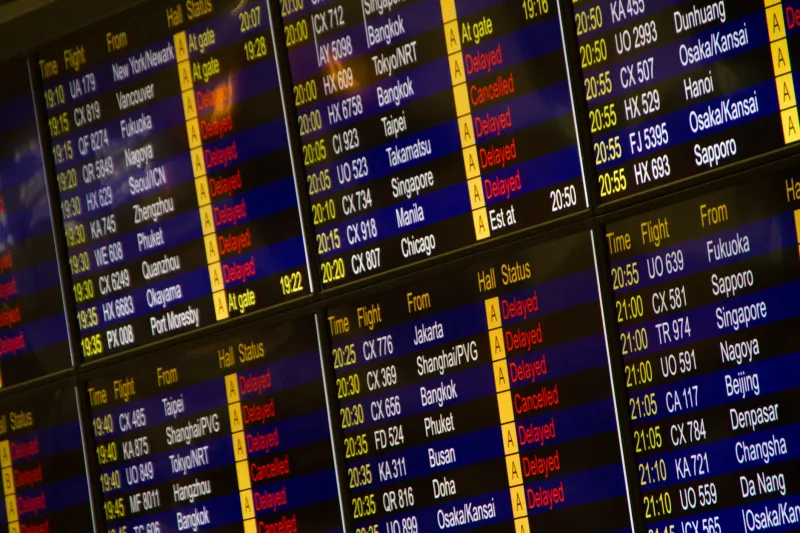
Every experienced simmer who has attempted to manage a realistic peak-hour gate schedule at a major US hub has encountered the same moment: a wide-body aircraft that was supposed to push back at 14:15 is still sitting at its gate at 14:30, and the inbound flight assigned to that gate is already on final approach. What follows is not merely an inconvenience. It is the beginning of a cascade failure that, if unmanaged, will still be generating delays ninety minutes after the original overstay began.
Understanding why this happens — and how to build simulation scenarios that replicate the real-world mechanics of terminal cascade failure — requires moving beyond individual gate management and into the systemic logic that governs how America's busiest airports absorb, propagate, and ultimately recover from single-point disruptions.
The Anatomy of a Cascade
At a high-utilization terminal, gate assignments are not static allocations. They are time-sequenced commitments, each one dependent on the successful completion of the one before it. When a wide-body aircraft fails to vacate its gate on schedule, the disruption does not stay local. It propagates through the schedule in a predictable but rapidly accelerating pattern.
The initial impact is straightforward: the inbound aircraft assigned to the occupied gate cannot park. It must either hold on the taxiway, divert to an alternate gate, or — in the worst case — return to the ramp holding area and wait for a resolution. Any of these outcomes consumes time and, more critically, consumes ground resources.
The secondary impact is less obvious but far more damaging. The inbound aircraft that cannot park is also carrying passengers who need to connect to outbound flights. Every minute that aircraft sits on the taxiway is a minute those passengers are not walking to their gates. Connection buffers that were already tight become impossible. Gate agents begin receiving calls about passengers who will not make their flights. Those outbound flights either hold at their gates — creating new occupancy overruns — or they depart with empty seats and generate misconnect costs.
The tertiary impact is where the cascade becomes genuinely difficult to contain. The gates that were held for those outbound flights are now delayed in turning over to their own inbound assignments. Within forty-five minutes of the original overstay, it is entirely possible for a single fifteen-minute delay to have touched six to eight gate assignments across a terminal that was already operating at ninety percent utilization.
Case Reference: Atlanta Hartsfield-Jackson (ATL)
ATL is the highest-utilization commercial airport in the United States and arguably the most instructive environment for studying cascade failure mechanics. Delta Air Lines operates the majority of the domestic terminal, and its hub-and-spoke model creates an operational structure where waves of arrivals and departures are scheduled in tight coordination.
During a peak bank — typically a ninety-minute window where thirty to fifty aircraft arrive, turn, and depart in coordinated waves — the margin for gate occupancy deviation is measured in single-digit minutes. A wide-body 767 or A330 overstaying its gate by fifteen minutes during a peak bank at Concourse A does not merely delay one arrival. It can compress the entire bank's departure window, forcing gate agents and ground crews into simultaneous triage decisions across multiple concourses.
For simmers attempting to replicate ATL operations authentically, this means that peak-hour gate management cannot be approached as a series of independent decisions. Every gate assignment must be evaluated in the context of the assignments immediately before and after it, with explicit buffer calculations built into the sequence.
Case Reference: Chicago O'Hare (ORD) and Dallas/Fort Worth (DFW)
ORD presents a structurally different cascade risk profile. Because United and American both operate major hubs at O'Hare, the terminal layout creates situations where cascade failures in one carrier's concourse can indirectly affect another carrier's ground operations through shared taxiway access and ramp control jurisdiction.
A wide-body overstay at a United gate in the B concourse that forces a holding pattern on Taxiway Yankee does not only affect United's schedule. It affects the flow of American aircraft attempting to access the C concourse from the south. The taxiway blockage becomes a shared operational problem even though the originating failure belongs entirely to one carrier.
DFW operates on a different model — its terminal layout, with five separate terminals arranged in a semicircle around a central airfield, means that cascade failures tend to stay within individual terminals more effectively than at ORD. However, the international terminal (Terminal D) is particularly vulnerable to wide-body overstay cascades because of the limited number of gates equipped with the infrastructure required for widebody international operations. A single A380 or 777 overstay can exhaust the available alternate gate options within minutes.
Building Contingency Gate Strategies in Simulation
Replicating these dynamics in simulation requires deliberate structural choices, not just reactive decision-making during a scenario.
Define your buffer gates explicitly. Before beginning any peak-hour scenario, designate at least two gates per concourse as contingency positions. These gates should be compatible with the largest aircraft type in your scheduled traffic and should not be assigned to any scheduled arrival during the peak window. They exist solely to absorb overstay displacements.
Model your cascade trigger thresholds. Establish in advance the overstay duration that will trigger a contingency response. For narrow-body aircraft, a reasonable threshold is ten minutes past scheduled block-out. For wide-body aircraft, reduce that threshold to seven minutes, reflecting the longer downstream impact of a large-aircraft displacement.
Sequence your contingency decisions. When a contingency gate is activated, immediately update the downstream assignment chain for the displaced gate. Do not treat the contingency activation as the end of the response — treat it as the beginning of a re-sequencing process that must propagate forward through the schedule for at least the next sixty minutes.
Track resource consumption, not just gate availability. Tug availability, ground crew positioning, and boarding bridge assignment are all consumed by contingency activations. A simmer who focuses exclusively on gate availability while ignoring ground resource depletion will find that the second cascade failure, which typically occurs thirty to forty minutes after the first, is significantly harder to contain because the resource pool has already been drawn down.
The Standard Real Dispatchers Hold
What separates a professional dispatcher at ATL or ORD from a simmer managing the same scenario is not access to better information — it is the discipline to make contingency decisions before the cascade begins, not after. Real dispatchers working peak banks at major hubs have already identified their contingency gates, pre-positioned their backup tugs, and mentally rehearsed their re-sequencing logic before the first aircraft of the bank touches down.
That discipline is the standard VDG SimDock encourages every serious simmer to pursue. Cascade failures are not random. They are predictable, they are patterned, and they are manageable — but only by simmers who have done the analytical work before the clock starts running.