Size Matters at the Gate: Decoding Aircraft-to-Gate Compatibility for Realistic Airport Simulation
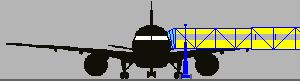
Photo: Roland Bergmann Dipl. Ing. (FH), CC BY-SA 3.0, via Wikimedia Commons
Flight simulation has never been more technically sophisticated. Aerodynamic modeling, weather systems, and avionics fidelity have all advanced considerably over the past decade. Yet one dimension of airport operations continues to receive surprisingly shallow treatment from most simulation platforms: the structured, rule-governed process by which a specific aircraft type is matched to a specific gate. At a busy US hub such as Chicago O'Hare, Dallas/Fort Worth, or Atlanta Hartsfield-Jackson, that matching process involves a layered hierarchy of physical, regulatory, and contractual constraints that the average gate assignment algorithm barely approximates.
Understanding those constraints—and learning how to embed them into custom airport builds—is the subject of this analysis.
The Physical Envelope: Why Wingspan Is Only the Beginning
Most simmers are familiar with wingspan as the primary gate-sizing criterion. It is, after all, the most visually obvious dimension. A Boeing 777-300ER with a 212-foot wingspan simply cannot share a ramp with a regional Embraer 175 without significant spacing adjustments. However, wingspan is only one variable in a more complex physical envelope.
Tail height determines whether an aircraft can be serviced by a given jetway without the bridge striking the fuselage during extension. Fuselage diameter and door sill height dictate whether an existing jetway can achieve a level, safe connection at all. Nose gear placement and cockpit overhang affect how far forward an aircraft can advance before its nose enters a restricted zone near the terminal facade. Each of these dimensions is codified in the ICAO Aerodrome Reference Code system, which classifies aircraft into categories—Code C through Code F—and assigns corresponding gate infrastructure requirements.
In the United States, the FAA's Advisory Circular 150/5360-13A provides detailed guidance on gate geometry, including the minimum wingtip clearance of 25 feet required between an aircraft and any fixed object during taxi-in and pushback. That 25-foot figure is not a suggestion. It is a safety-of-flight standard, and at congested terminals where gates were designed decades before widebody operations became routine, achieving it requires deliberate, sometimes creative ramp management.
Equipment Compatibility: The Jetway as a Precision Instrument
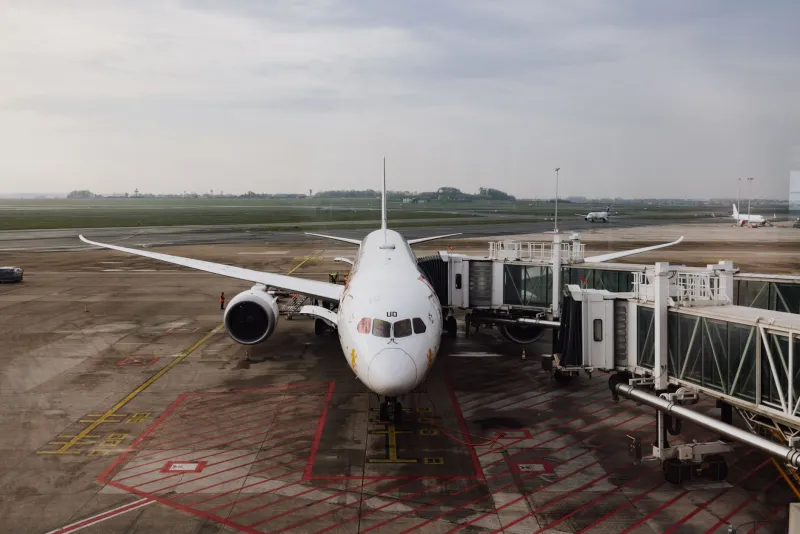
The passenger boarding bridge—commonly called the jetway—is frequently treated in simulation as a purely cosmetic element that animates upon docking. In reality, it is a piece of precision ground support equipment with defined operational limits.
Modern jetways at US major airports typically accommodate aircraft ranging from narrow-body single-aisles up to the Boeing 747 or Airbus A330. However, ultra-large aircraft such as the Airbus A380 require dual-bridge configurations, with a second bridge serving the upper deck. Only a handful of US airports—Los Angeles International being the most prominent domestic example—invested in A380-capable infrastructure, and even at LAX, that capability is concentrated at specific gates within Tom Bradley International Terminal.
Beyond bridge reach and articulation range, ground power unit (GPU) placement, pre-conditioned air (PCA) connections, and potable water service points are all physically fixed. An aircraft with service panel locations that do not align with a gate's fixed infrastructure creates a ground support problem, even if the aircraft fits the physical envelope. Simmers building custom airports should assign service point locations as a gate attribute, not merely as a visual decoration.
Pavement Load Classification and the Hidden Constraint
Beneath every ramp surface lies a pavement structure rated for a specific aircraft classification weight. The FAA's Aircraft Classification Number / Pavement Classification Number (ACN/PCN) system governs this relationship. A gate ramp designed for Code C narrow-body operations may carry a PCN rating insufficient for repeated widebody movements, particularly in the case of aircraft with high single-wheel or dual-tandem gear loads.
At several older US terminals, this pavement constraint is the binding limitation—not wingspan or jetway reach. The gate may appear physically capable of accommodating a larger aircraft, but dispatching that aircraft to the gate would exceed the pavement's structural rating and accelerate deterioration. Airlines and airport operations departments maintain internal databases that flag these restrictions, and gate assignment software incorporates PCN data as a hard constraint.
For simulation purposes, assigning a PCN attribute to each gate and enforcing it as a filter during aircraft assignment would represent a meaningful step toward operational authenticity.
Airline-Specific Leasing and Preferential Use Agreements
Beyond physical constraints, US airports operate under a complex framework of gate leasing arrangements. Major carriers at their hub airports typically hold exclusive-use gates—gates that no other airline may occupy without explicit permission, regardless of availability. Secondary carriers operate under preferential-use agreements, granting priority access while permitting the airport to assign the gate to other operators during idle periods. Smaller regional operators and charter carriers usually access common-use gates, which are allocated dynamically by the airport's gate management system.
This contractual layer is invisible to most simulation platforms, yet it profoundly shapes real-world gate assignment. A Southwest Airlines aircraft at Dallas Love Field will never occupy a gate leased exclusively to another carrier, even if that gate is physically compatible and momentarily vacant. Replicating this constraint in a custom airport requires defining gate ownership attributes and building assignment logic that respects those ownership boundaries before evaluating physical compatibility.
Building Authentic Constraints Into Your Custom Airport
Translating this framework into simulation practice requires a structured approach to airport data architecture. The following methodology is recommended for simmers seeking maximum fidelity.
First, assign each gate an ICAO Reference Code classification and a corresponding maximum aircraft category. This single attribute eliminates the most egregious mismatches—widebodies at commuter gates—with minimal configuration overhead.
Second, define jetway capability as a discrete attribute set, noting whether the gate supports single-bridge narrow-body service, single-bridge widebody service, or dual-bridge ultra-large aircraft service. Link this attribute to the aircraft door configuration data your simulation platform exposes.
Third, incorporate a simplified PCN rating and enforce it as a filter for aircraft with high pavement load classifications. Even a binary heavy/light designation captures a meaningful portion of real-world constraint behavior.
Finally, assign each gate an operator ownership flag—exclusive, preferential, or common-use—and build airline assignment logic that checks ownership before evaluating physical compatibility. The result is a gate assignment system that behaves with recognizable fidelity to the way major US hub airports actually function.
The Authenticity Dividend
The effort invested in accurate gate compatibility modeling pays dividends that extend beyond technical correctness. When aircraft are constrained to gates that genuinely fit them, ramp congestion patterns emerge organically, pushback routing becomes more demanding, and the operational texture of a busy hub becomes perceptible in ways that a permissive assignment system simply cannot produce.
Mastering the gate, in the truest sense, means understanding why every gate has limits—and building those limits into your simulation with the same rigor that airport engineers apply to the real thing.