Hands On the Walk-In: Decoding the Marshaller's Vocabulary Every Stand Entry Demands
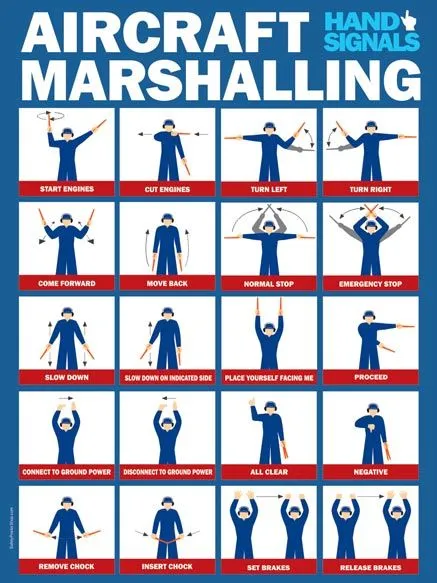
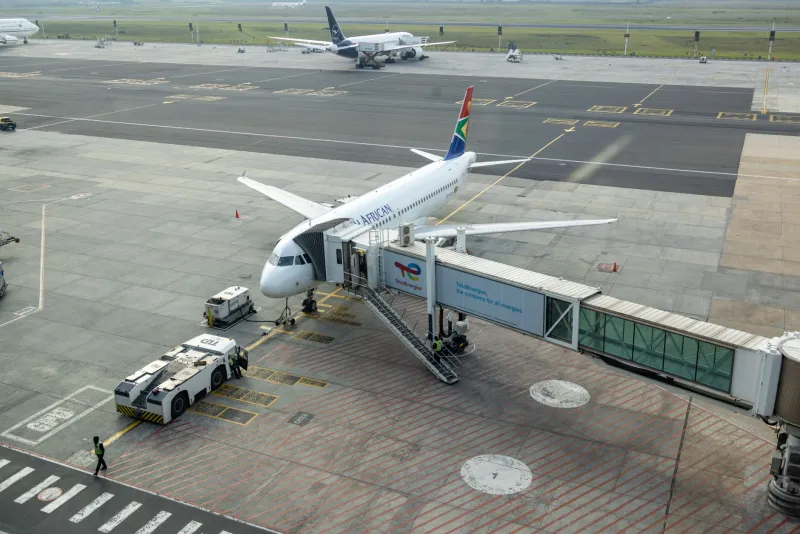
Photo: aircraft marshaller hand signals flight deck view gate arrival, via i.pinimg.com
There is a moment on every real airline arrival that flight simulation routinely flattens into background noise: the walk-in. The captain slows the aircraft to a crawl, the autobrake is disarmed, and a human being standing on the pavement becomes the single most important instrument on the ramp. What happens next is not pantomime. It is a codified, internationally standardized exchange of hand signals — and if your stand entries don't account for it, you're skipping one of the most demanding skills in line-flying.
The Language of the Ramp
The backbone of marshaling communication in the United States comes from the FAA's Airport Safety and Standards guidance, which aligns closely with ICAO Annex 2 and the IATA Airport Handling Manual. The signals are deliberate, exaggerated, and designed to be read from a flight deck seventy feet above the pavement and hundreds of feet back from the source.
A few of the signals every simmer should be able to read on sight:
- Wings level / lateral movement. Both arms extended horizontally, moving them up and down in slow sweeps. This tells the captain where the aircraft sits relative to the stand centerline — and how much correction is needed.
- Proceed forward. One arm raised, sweeping overhead and forward. In the sim, this is your cue to release brakes and begin the taxi-in at walking pace.
- Slow down. Arms moved up and down at a faster, choppier cadence. If you're seeing this in real life, you've already carried too much energy past the taxiway turn.
- Stop / hold. Crossed arms raised above the head. Non-negotiable, immediate, and the one signal that overrides everything else.
- Turn to port or starboard. One arm lowered, the other sweeping across the body in the direction of the turn — the visual shorthand for how a nosewheel steering input will translate on the pavement.
- Chocks inserted and pull-away complete. The final handshake of the arrival, confirming the aircraft is secure and ground contact is ended.
What makes the system elegant is its redundancy. The marshaller doesn't just signal turns; the cadence of each movement communicates urgency. A calm sweep is a routine correction. A rapid, truncated gesture means stop thinking and react.
How Well Do the Major Add-Ons Actually Replicate This?
Honest answer: inconsistently. GSX has done more than any single product to make the walk-in an active event, with its follow-me and docking sequences responding to your groundspeed and lateral position — and if you drift off the centerline, it will halt you and force a correction. Default scenery in MSFS and X-Plane, by contrast, tends to animate a marshaller who waves enthusiastically regardless of what the aircraft does, which teaches exactly the wrong habit.
The fidelity gap shows up most in the failure states. A real marshaller stops the aircraft the instant alignment degrades. Very few sim add-ons will actually refuse to complete a docking sequence because you came in hot or two meters off the line. Until that changes, the burden of realism sits with the pilot.
Flying the Stand Entry Manually
If you want to dock the way a line pilot does — no autopilot taxi, no docking guidance screen, no autopark — here is a practice progression that works:
- Set the approach speed before the turn. Real stand entries happen at a brisk walking pace, roughly 3 to 5 knots. Establish that before the lead-in line, not during it.
- Pick your reference point. Real crews use the aircraft nose and the stand centerline, not a screen. In the sim, force yourself to fly the entry from the captain's eyepoint with the marshaller in view — no external camera.
- Read the signal, then the result. If your add-on's marshaller gestures for a lateral correction, make the nosewheel input, wait for the fuselage to follow, and watch for the confirming signal before continuing. Most simmers correct once and assume; real crews correct, confirm, and reconfirm.
- Practice the abort. Call your own stop. Come to a full halt two-thirds down the lead-in line, hold, and restart the entry from a standstill. Restarting a docking sequence smoothly is harder than doing it in one motion, and it's the skill you'll actually need on a congested ramp.
- Log your stopping accuracy. Note where your nosewheel gear ends up relative to the stop bar. A foot of error is normal. Three feet means your eye discipline needs work.
Why This Matters More Than It Seems
The walk-in is the only phase of flight where the pilot's hands and eyes are managed entirely by someone else's judgment. Embracing that dependency — slowing down, reading the gestures, surrendering the ego of the smooth arrival — is what separates simmers who fly gates from simmers who merely park at them. The pavement is talking. Learn the language.