Frozen Out: Why Deicing Is the Missing Season Your Simulation Never Had
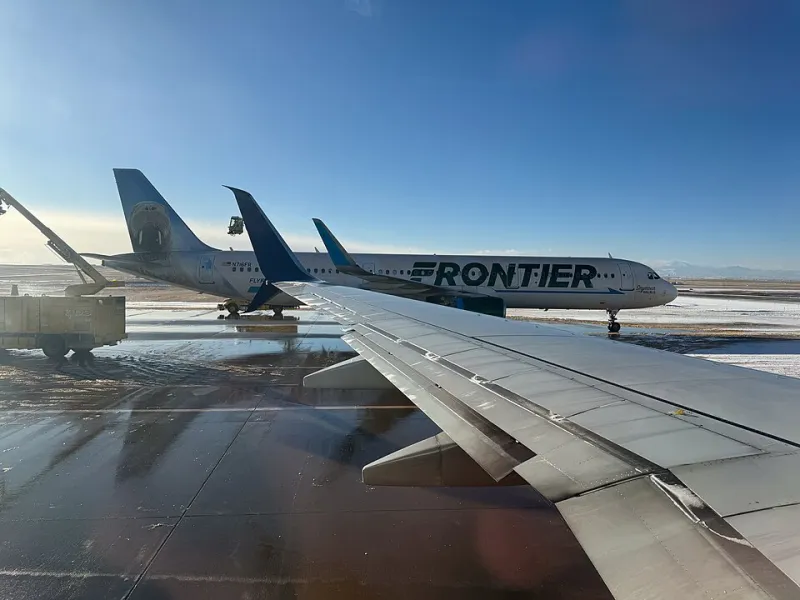
Photo: Tony Webster, CC BY 2.0, via Wikimedia Commons
Here is an uncomfortable question for the ground-operations simulation community: when was the last time a winter departure made you sweat? Not a snow texture on the runway — an actual, operationally demanding deicing sequence, with a holdover clock ticking and a queue of aircraft stacking up behind you at the pad.
For most of us, the answer is never. And that gap says something important about where the hobby's priorities have drifted.
What Deicing Actually Involves
In the real world, deicing is not a truck spraying the wings while the captain checks email. It is a tightly choreographed, time-critical procedure governed by FAA Holdover Time tables — documents that specify, for every fluid type and every precipitation intensity, exactly how many minutes of protection the aircraft has before it must be airborne or deiced again.
At major winter hubs like Denver and Chicago O'Hare, this creates one of the most operationally complex environments in aviation. Aircraft taxi to dedicated deice pads — DEN operates multiple large pads on the west side of the airfield — where crews queue, receive fluid type and mixture from the deice operator, undergo a full tactile inspection, and then launch into a departure flow that has been recalculated around a clock that started the moment Type IV fluid hit the leading edge.
The consequences ripple everywhere. A holdover expiration forces a return to the pad, burning a second slot in an already saturated queue. Deice pads become hidden bottlenecks that no gate-management system accounts for. Departure runways see flow rates collapse because every departure is now sequenced against a fluid timer, not just a takeoff interval.
Why the Sim World Has Looked Away
The neglect is understandable. Deicing doesn't photograph well the way a jetbridge docking sequence does, and implementing it faithfully requires systems almost no add-on currently has: holdover timers that integrate with weather engines, pad queue logic, fluid-type selection tied to real meteorological conditions, and departure sequencing that respects an expiring clock.
But understandability is not an excuse. Winter operations account for some of the most dramatic capacity collapses in US aviation — the January 2024 Southwest meltdowns and countless DEN snow events demonstrated how quickly a hub's entire gate-and-departure structure can seize when deicing throughput drops. A simulation that pretends this dimension doesn't exist is simulating an airport that only operates nine months a year.
What Developers Should Build
The blueprint is not mysterious. A credible winter operations module needs four things:
- Holdover time integration. Pull precipitation type and intensity from the active weather engine and compute a live holdover clock. Present it on the flight deck the way a real crew sees it — as a deadline, not a suggestion.
- Deice pad queue simulation. Pads with finite positions, sequencing logic, and ground equipment availability. A queue that builds and dissipates is the entire drama.
- Re-deice consequences. Let the clock expire. Force the taxi back. Make the cost real, because in the real world it absolutely is.
- Gate-flow coupling. Deice delays should back-propagate into gate occupancy, because that's exactly what happens at ORD and DEN — a departure that can't launch is a gate that can't turn.
The Case for the Cold
For simmers, the argument is simpler: winter flying is the hardest flying, and the hardest scenarios are where this hobby earns its keep. We have spent years building exquisite machinery for gate assignment, pushback logic, and bridge alignment. The final boss of ground simulation is waiting in the snow queue at a deice pad, watching a timer, knowing the departure runway behind you is jammed with aircraft in exactly the same position.
Some developer will build this properly, and when they do, it will redefine what a realistic airport simulation means. Until then, the winter season remains the empty hangar at the edge of the hobby — enormous, obvious, and inexplicably locked.