Hands in the Air: Decoding the Spatial Intelligence Behind Real-World Ramp Marshal Guidance
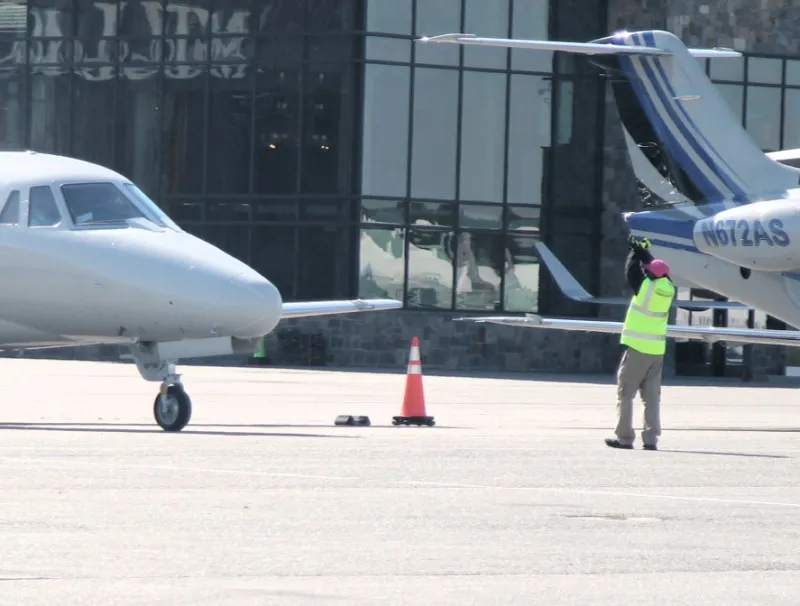
Photo: Coldstreamer20, CC BY 4.0, via Wikimedia Commons
There is a moment, familiar to anyone who has watched ground operations from a terminal window, when a 180-foot aircraft threads itself into a gate slot with only feet of clearance on either side. The aircraft moves with deliberate, almost implausible calm. What appears effortless from above the jetway is, at ground level, the product of precise communication, practiced spatial reasoning, and an intimate understanding of aircraft geometry. The ramp marshal standing on the tarmac is not simply waving batons. That individual is performing a form of three-dimensional calculus in real time.
For simulation pilots committed to authentic gate operations, understanding what marshals actually do — and why their signals mean what they mean — is the difference between a docking sequence that looks convincing and one that looks like an educated guess.
The Geometry the Marshal Carries in Their Head
Before a single signal is thrown, an experienced ramp marshal has already conducted a mental survey of the environment. They know the wingspan of the inbound aircraft, the location of every fixed obstacle within the gate box, and the precise stopping point marked by the lead-in line. At congested US hub airports — think Atlanta's Concourse T, Chicago O'Hare's F gates, or the notoriously dense domestic terminals at LAX — gate boxes are engineered with minimal buffer. Clearances between a parked aircraft's wingtip and an adjacent structure can fall as low as eight to ten feet in some configurations.
The marshal positions themselves not arbitrarily, but at a calculated sightline that allows them to monitor both wingtips simultaneously while maintaining visual contact with the flight deck. This is not always possible from a single static position. Experienced personnel frequently adjust their stance as the aircraft advances, stepping laterally to maintain an unobstructed view of the critical clearance points. That lateral movement is intentional choreography, not restlessness.
Reading the Signal Language Accurately
Standard marshaling signals are codified under FAA Advisory Circular 150/5210-7 and adopted across US commercial operations, but the nuance lies in how those signals are delivered, not merely what they represent.
Straight-in guidance — both arms raised, palms facing inward, moving toward each other — communicates more than a simple "come forward." The speed of the arm movement corresponds directly to the desired taxi speed. Slow, deliberate cycling means reduce pace. Rapid cycling is rarely used in the final approach phase; if you see it, the marshal is signaling urgency, typically because of an unexpected obstacle entering the gate box.
Turning signals require particular attention. When a marshal extends one arm horizontally and sweeps the other in a beckoning arc, they are not pointing toward a destination. They are indicating the direction the nose should travel. A simmer interpreting this signal as "go that way" rather than "turn your nose that way" will drift wide of centerline within seconds. The distinction is subtle in description and consequential in practice.
The stop signal — arms crossed above the head — is absolute. In real operations, this signal is practiced until it becomes reflex. The aircraft must stop immediately, regardless of perceived distance to the painted stopping mark. Marshals issue this signal when their spatial calculation indicates that continuing forward creates unacceptable risk, even if the cockpit crew's perspective suggests otherwise.
Why Confined Gates Demand a Different Level of Attention
Open-ramp parking and remote stand operations are forgiving environments. Confined gate approaches at major hub airports are not. The variables compound quickly: adjacent aircraft at neighboring gates, ground service equipment that may be partially outside the marshal's sightline, jet blast considerations from aircraft on nearby taxiways, and the cumulative effect of minor directional drift over a 200-foot final approach.
Real marshals working confined gates at airports like JFK Terminal 4 or Dallas/Fort Worth's Terminal D develop what experienced ramp supervisors describe as "peripheral depth perception" — the ability to judge three-dimensional clearances from a two-dimensional viewing angle. This skill is built through repetition and is not fully teachable in a classroom. It is, however, partially transferable through deliberate study of the spatial relationships involved.
For the simmer, developing an approximation of this awareness begins with one foundational habit: never fix your view solely on the nose gear or the stopping mark. Experienced gate pilots in the sim divide their attention across the full cockpit view, using external camera perspectives judiciously to verify wingtip clearance before committing to the final approach corridor.
Translating Marshal Intelligence Into Sim Practice
Most modern simulation platforms, including Microsoft Flight Simulator and X-Plane with appropriate ground operations add-ons, render marshaling personnel whose signals correspond to the aircraft's position. The following practices will help you extract maximum value from those interactions.
Establish your approach speed early. Real aircraft enter the gate lead-in at a walking pace or slower — typically under five knots by the time the marshal acquires visual contact. If you are arriving at the marshal's position above that threshold, you are already behind the operational curve.
Treat the marshal's position as a sightline anchor. In the sim, as in real operations, the marshal stands where they can see your critical clearance points. If your viewing angle makes their signals ambiguous, switch briefly to an external perspective to confirm aircraft geometry, then return to the cockpit to complete the stop sequence.
Practice the stop-signal reflex. Configure your simulator to use a keybinding or hardware control that allows an immediate brake application. When the marshal's stop signal appears, your response should be automatic. Delayed reactions in a confined gate environment translate directly into contact incidents.
Study gate diagrams before flying. Airport charts, including those available through Navigraph and Jeppesen, contain gate box dimensions and clearance notes. Reviewing these before a session gives you the same pre-approach mental model that real marshals carry onto the ramp.
The Margin for Error Is Not a Cushion
One of the most important conceptual shifts a simulation pilot can make is to stop treating gate clearance margins as tolerances and start treating them as absolute limits. In real operations, the eight-foot clearance between a B737 wingtip and a terminal column at a confined domestic gate is not eight feet of room to maneuver. It is eight feet that must remain intact.
Ramp marshals understand this viscerally because they are standing within that margin. Their spatial intelligence is not an abstract skill — it is a survival mechanism for the aircraft, the equipment, and the people working around both. When you internalize that perspective, the marshal's signals transform from a graphical overlay into a genuine operational communication system.
At VDG SimDock, the standard we hold for gate operations is the same one that ramp supervisors hold at every major US hub: precision is not a preference, it is a professional expectation. The marshal is not there to catch your mistakes. They are there to guide you through a corridor that was designed with no room for any.
Master the signals. Respect the geometry. Own the gate.