Loaded Wrong, Landed Crooked: How Weight and Balance Errors Corrupt the Final Gate Sequence
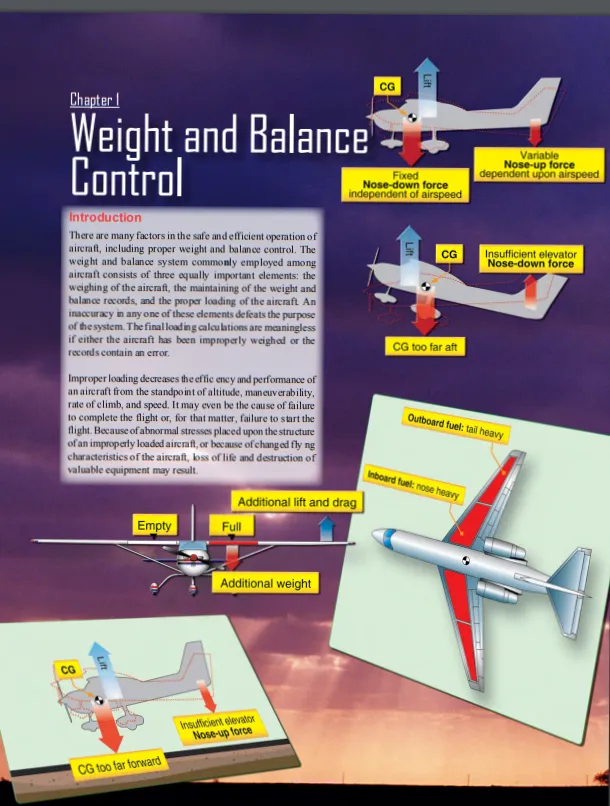
Photo: U.S. Department of Transportation FEDERAL AVIATION ADMINISTRATION, Public domain, via Wikimedia Commons
There is a particular frustration familiar to experienced gate simmers: the approach looks clean, the speed is stabilized, the centerline appears perfectly centered on the VGSI—and yet something is subtly, persistently wrong. The aircraft drifts. The flare feels uneven. The final taxi to the gate requires constant correction that should not be necessary. The instinct is to blame the scenery mesh, the crosswind model, or a suspected add-on conflict. In most cases, the actual culprit is sitting quietly in the payload manager, untouched since the aircraft was first installed.
Weight and balance configuration is one of the most technically consequential and routinely neglected settings in the flight simulation workflow. This analysis examines precisely how an incorrect center of gravity—whether forward-biased or aft-biased—produces a cascade of handling anomalies that manifest most visibly during the final approach segment and the docking sequence that follows.
Why the Gate Approach Is the Most Sensitive Phase
At cruise altitude and high airspeeds, small CG errors are largely absorbed by the aircraft's stability margins and autopilot trim authority. The flight model has room to compensate. As the aircraft descends through the terminal environment, however, those margins compress rapidly. Airspeed decreases, control surface authority diminishes, and the aircraft becomes measurably more responsive to any imbalance in its mass distribution.
By the time a simulated aircraft crosses the outer marker on a visual approach to a gate at a hub like Chicago O'Hare or Dallas/Fort Worth, it is operating in a regime where a CG that sits even a few percentage points outside the ideal range will produce observable, reproducible behavioral anomalies. These are not dramatic failures. They are subtle enough to be mistaken for environmental factors—which is precisely what makes them so difficult to diagnose without a structured methodology.
Forward CG: The Overloaded Nose Problem
A forward-biased center of gravity is the more common configuration error among simmers who load aircraft without consulting the payload documentation. The instinct to fill seats and cargo holds uniformly—or to copy a load from a previous flight without adjusting for a different aircraft variant—frequently produces a nose-heavy condition.
The aerodynamic consequences are well-documented in aviation literature and translate faithfully into high-fidelity simulation environments. A forward CG demands increased back pressure during the flare, which in practice means the pilot must apply more elevator input at precisely the moment when precision matters most. In simulation, this often manifests as a nose-low touchdown attitude that places the main gear on the runway earlier and harder than intended. The aircraft then rolls out with a slight but persistent tendency to track left or right depending on the specific asymmetry introduced by the load.
The downstream effect on gate docking is direct. An aircraft that completes its rollout with residual directional instability requires more aggressive nosewheel steering input during the taxi to the gate. That increased input introduces its own oscillation, and the pilot arrives at the final 200 feet of the docking sequence already fighting a correction cycle rather than executing a smooth, stabilized approach to the stop bar.
Aft CG: The Deceptive Lightness That Becomes a Trap
An aft-biased CG presents a different and in some ways more dangerous failure mode, because its initial handling characteristics can feel desirable. The aircraft responds more crisply to elevator input, requires less back pressure in the flare, and often produces what feels like an unusually smooth touchdown. Simmers who encounter this configuration sometimes interpret it as evidence of a well-tuned aircraft rather than a misconfigured one.
The problems emerge during the rollout and low-speed taxi phase. An aft-heavy aircraft is inherently less stable about its pitch axis, which means that minor undulations in the taxiway surface—modeled with varying fidelity across different airport add-ons—produce pitch oscillations that would be damped out in a properly loaded aircraft. More critically, nosewheel authority is reduced when weight is biased toward the tail, making precise directional control during the final gate approach measurably more difficult.
In dense gate environments—the kind found at terminals modeled after LAX's Tom Bradley International or Atlanta's Hartsfield-Jackson concourses—this reduced nosewheel authority translates into a wider turning radius and a tendency to overshoot the centerline on the final approach to the jetway. The pilot compensates, overcorrects, and the aircraft arrives at the stop bar at an angle that the simulation may or may not penalize depending on the scoring logic of the platform being used.
Lateral Asymmetry: The Variable Most Simmers Never Check
Foreward and aft CG errors receive the most attention in simulation communities, but lateral weight asymmetry—an uneven distribution of mass between the port and starboard sides of the aircraft—is arguably the more insidious problem. It is also the one least likely to be caught during a casual preflight check.
A lateral imbalance produces a persistent rolling tendency that the autopilot or flight director can mask at cruise but which becomes fully apparent during the manual phase of the approach. The aircraft wants to track in the direction of the heavier wing. The pilot applies aileron to correct, which introduces a coordinated rudder input, which in turn affects the aircraft's heading. The result is an approach that requires constant, low-amplitude control inputs to maintain alignment—inputs that accumulate fatigue and increase the likelihood of a misaligned touchdown.
For gate docking purposes, a laterally asymmetric aircraft that touches down with a slight crab angle will not self-correct during rollout. The pilot must apply differential braking or aggressive nosewheel steering to straighten the aircraft, and by the time those corrections have been made, the smooth, stabilized approach to the gate has already been compromised.
Auditing Your Aircraft Payload Profile
The practical solution begins before the first engine is started. Every aircraft profile used for gate operations should be audited against the manufacturer's loading documentation, which reputable add-on developers include in their documentation packages or model within the aircraft's flight management system.
The audit process involves three steps. First, verify that total payload weight falls within the aircraft's certified maximum zero fuel weight. Second, confirm that the resulting CG, expressed as a percentage of mean aerodynamic chord, falls within the forward and aft limits for the flaps configuration planned for landing. Third, check lateral balance by reviewing the left-right distribution of passenger and cargo loads and adjusting any asymmetries that exceed the aircraft type's published tolerances.
Simulators that model weight and balance with high fidelity—including current-generation platforms used by the VDG SimDock community—will reflect these corrections immediately in the aircraft's handling characteristics. A side-by-side comparison of an identically modeled aircraft with a correct CG versus an incorrect one, flown on the same approach to the same gate under identical weather conditions, will produce measurably different outcomes at the stop bar.
Eliminating the Variable Before It Eliminates Your Approach
The gate is an unforgiving endpoint. Every error introduced earlier in the flight—whether in the preflight configuration, the approach briefing, or the weight and balance setup—arrives at the jetway with the aircraft. Weight and balance errors are particularly costly because they are invisible in the moment and easy to rationalize as something else.
Building a habit of payload verification into the pre-departure flow is the most reliable way to remove this variable from the equation. The approach will be cleaner. The rollout will be straighter. And the final 200 feet to the gate will demand the kind of precise, deliberate control inputs that gate simulation, at its best, is designed to reward.